
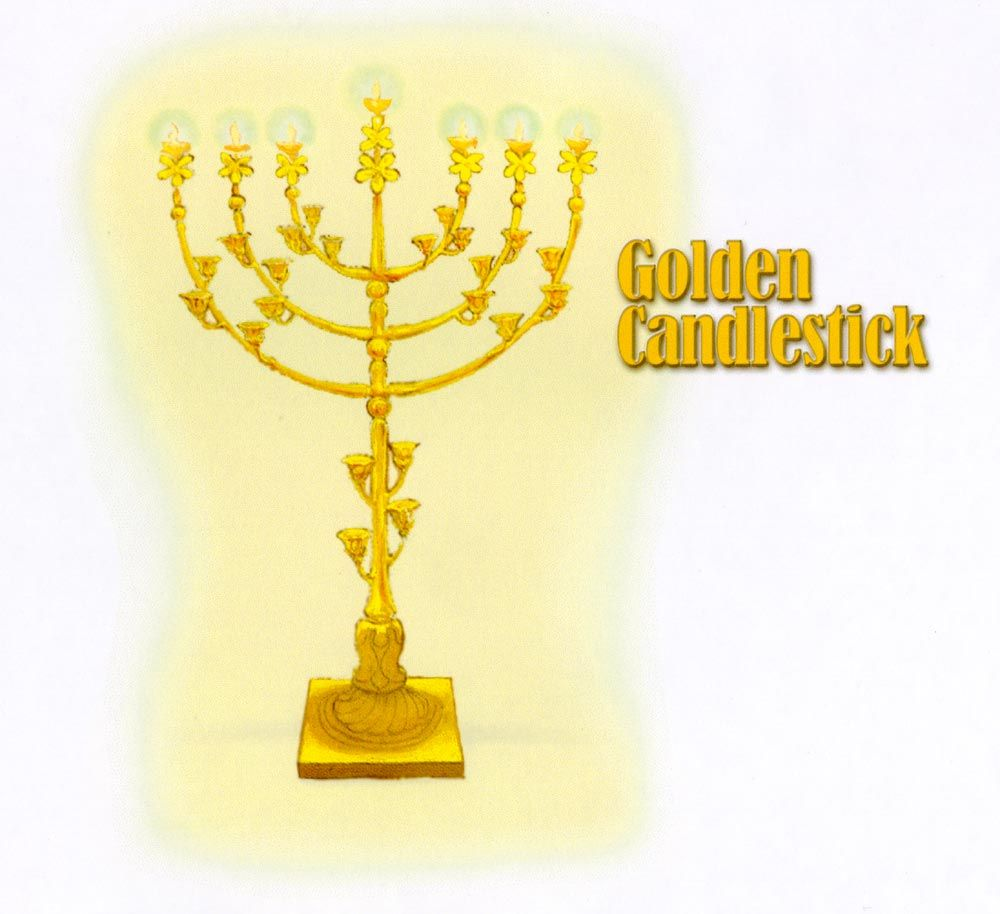
The picture depicts the construction of the candlestick in the tabernacle. It is a man made effigy of Aaron’s rod that budded, flowered and bore a crop, a generation, of almonds. Aaron’s resurrected rod is in turn, a figure of the resurrection of Christ. The title “Christ”, means that the fullness of the anointing, the entirety of the Spirit of God, dwells in Christ. It is declared that, if the same Spirit that raised Christ from the dead dwell in you, it shall quicken, even your mortal body. It says that by one Spirit are you baptized into (immersed into) one body. The entire candlestick is of one beaten work of gold, signifying what the scriptures call the common salvation. All who call upon the name of the Lord shall be saved. But among the seven bowls made to resemble almonds, there is a distinction. Four are void of oil, and hence, void of internal light. Seven are filled with oil, and give light. Exodus 25 gives an account of this.
Joseph was a figure of the man, and subsequent household, of resurrection. The candlestick was made in fashion, to mirror the events in Joseph’s life that told of Christ. Joseph’s dreams told of the sun, moon, and eleven stars diminished in the light of Joseph’s star. He told of the eleven sheaves bowing to his sheaf. Joseph’s brethren hated him for his favored status, and hated him the more because of his dreams. So despised was Joseph, that they could not even speak peacefully to him. They made a false assumption. Joseph’s God given dreams were not, as they assumed, declaring that Joseph would rule over them. The dreams were declaring how God would fulfill His promises to the fathers. When Joseph later was cast into a pit by his brothers to die, his “star” as a son of Jacob figuratively died. When Joseph was raised out of the pit, he became another “star”. He became a figure of the Bright and Morning Star, the Man of Resurrection, leaving eleven stars in Jacob. David wrote of Joseph, that from the time he came up out of the pit, for thirteen years, until the word of the Lord was fulfilled in him, the word of the Lord tried him. Despite everything in his life bearing no resemblance to his dreams, would Joseph hold to them in faith? Joseph endured chastisement because of his vision.
The book of Ruth tells us that the house of Israel was built in Rachel and Leah, who were wives. Genesis 37 tells you that the house of Jacob was built in Zilpah and Bilhah, his wife’s slaves. Eight sons of wives, four of slaves. Remove Joseph, now a different house, and you have eleven sons. Seven and four, which is reflected in the candlestick. Seven oil filled, four having no oil. The Promise of the Father is the Anointing. Hence, seven sons born to wives and heirs of the promise. Four born to slaves, and can not be heirs of promise. This message is 100% spiritual. It has nothing to do with blood lines, and everything to do with the principle that the son of a bondwoman can not be heir in the same household, with the son of a bondwoman. Sons of works can not inherit, what can only be inherited, that which is promised, by faith. To inherit something by faith, one has to know what he/she believes. Joseph believed what God showed him, and was justified by faith. His household lumbered on in the patriarchal vision of carnal authority structure, blood lines, and real estate. But to be clear, any descendant of anyone, anywhere, can be heir with Christ by faith. When Paul wrote that, by faith, Isaac blessed both Jacob and Esau concerning things to come, Isaac recognized that one would come who would be heir of all promises. And by faith in that one, ANYONE can be justified, and added to Him.
Later Paul would write of the two great houses, of religious works and faith. Paul said that Jerusalem above is the household of faith, and is the mother of us all. Jerusalem beneath is the household of bondage. She is a slave, and her children are born into bondage. In flesh and blood, no one can change his or her ancestry. But in Christ, everyone has the same opportunity by faith, to be translated out religious bondage, into the glorious liberty of the Sons of God. Jerusalem above, is a house of many houses. In each house, “My Father’s house”, each dwells in fellowship with the Father and with the Son. In each house, two dwell together as one. One of the two is the Lord. The other of the two is you!
Look at the candlestick. Consider it’s constitution. Consider the allocation of the oil, the Anointing. Now consider that, as many as are lead of the Spirit of God, They are the sons of God.
Joseph walked in faith in what was shown him of God. It was not contrary to Jacob’s patriarchal vision, but it revealed that vision to be a shadow. It showed HOW God would fulfill all the promises made to Abraham, in one who would come out of Abraham, and would be given a ransom for not only all descended from Abraham who would receive this in faith, but for all peoples everywhere who would receive this in Faith, without any distinction.
This great message written into the candlestick, and other places, carries with it, another great message. Paul framed this in writing the book of Hebrews, particularly Chapter eight. I encourage all to read it with a view to the difference between how the Lord deals with a son and a bastard. I use the word bastard, because it is only used in this place, in all of the New Testament. And knowing the meaning of the word is very important. It means someone born in a house, to a slave or concubine.
STRONGS G3541:
νόθος, νοθη, νοθον, illegitimate, bastard, i. e. born, not in lawful wedlock, but of a concubine or female slave: Hebrews 12:8; cf. Bleek at the passage (Wis. 4:3; from Homer down.)
For consider him that endured such contradiction of sinners against himself, lest ye be wearied and faint in your minds. Ye have not yet resisted unto blood, striving against sin. And ye have forgotten the exhortation which speaketh unto you as unto children, My son, despise not thou the chastening of the Lord, nor faint when thou art rebuked of him: For whom the Lord loveth he chasteneth, and scourgeth every son whom he receiveth. If ye endure chastening, God dealeth with you as with sons; for what son is he whom the father chasteneth not? But if ye be without chastisement, whereof all are partakers, then are ye bastards, and not sons. Furthermore we have had fathers of our flesh which corrected [us], and we gave [them] reverence: shall we not much rather be in subjection unto the Father of spirits, and live? For they verily for a few days chastened [us] after their own pleasure; but he for [our] profit, that [we] might be partakers of his holiness. Now no chastening for the present seemeth to be joyous, but grievous: nevertheless afterward it yieldeth the peaceable fruit of righteousness unto them which are exercised thereby. Wherefore lift up the hands which hang down, and the feeble knees; And make straight paths for your feet, lest that which is lame be turned out of the way; but let it rather be healed.
As in all things, the scriptures are without respect of persons, because the Lord is no respecter of persons. Everything that is in Christ, is obtainable in the Spirit, by faith, to all, without distinction or respect of person. This is choice. This is grace. This is the truth. This is Christ. The admonition of Hebrews eight tells you that if you endure chastening, there is in that, great cause for rejoicing. Because it is part of the regimen of a son. The word “chastisement” further conveys this.
παιδεύω paideúō, pahee-dyoo’-o; from G3816; to train up a child, i.e. educate, or (by implication), discipline (by punishment):—chasten(-ise), instruct, learn, teach.
As Paul said, chastening is not pleasant, but it has two great components. It tells you who your Father is, and it produces benefits in your being.


 Mythology Buster